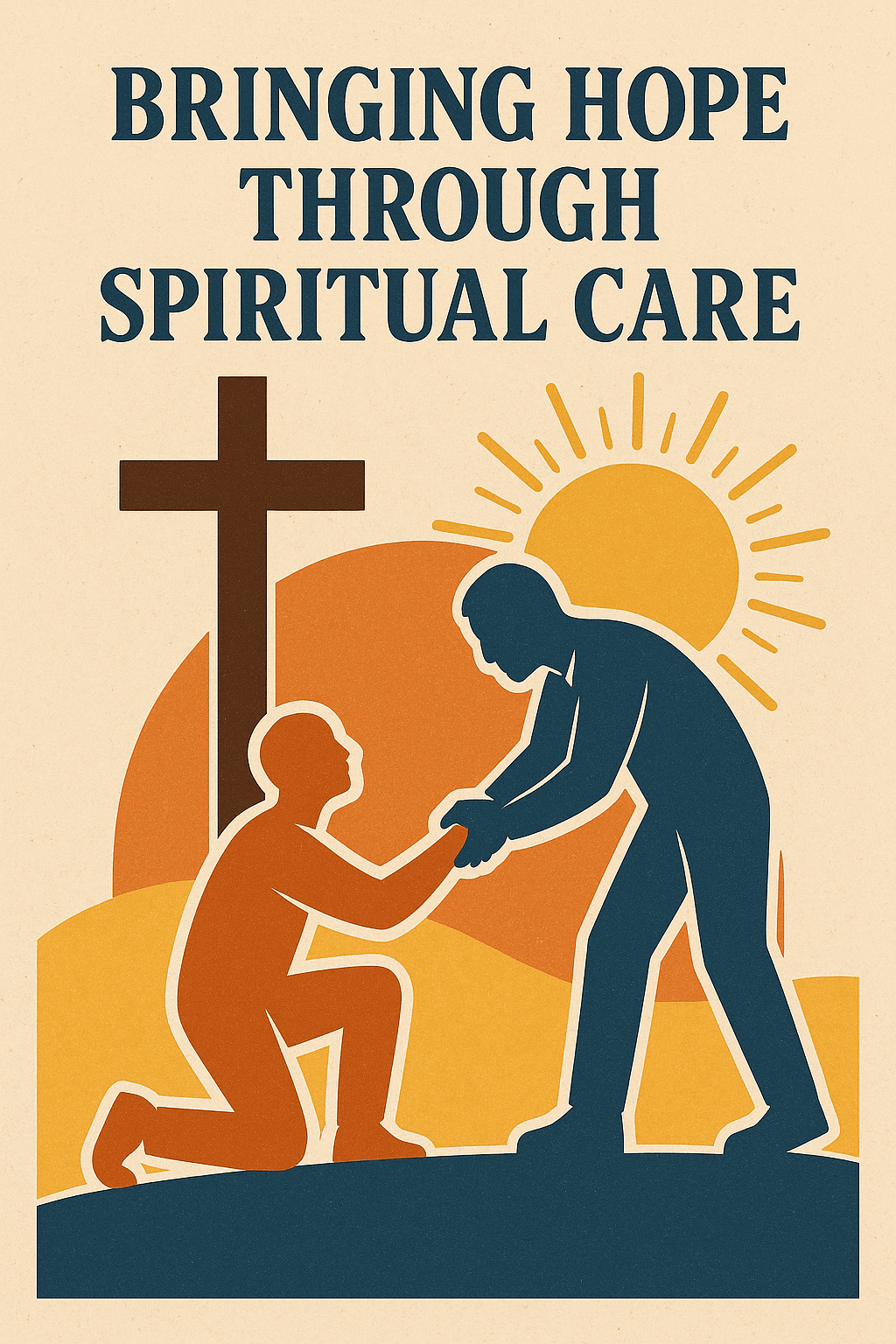
The purpose of this reflection – I have chosen to use the book, “Hope in Pastoral Care and Counseling” by Andrew Lester. I chose this book because it best shows how I practice spiritual care in a clinical setting. The whole premise of the book is that pastoral care in a clinical setting seeks to integrate theological concepts like purpose, hope, and meaning into the development of our stories and how we process life. The theology of the book best models how I understand God and clinical spiritual care. My view is a Christ-centered view, which is all about hope through the Gospel, finding purpose in God, and growing spiritually through the grace of Jesus Christ. In this paper I want to show how I integrate the theoretical paradigm of Andrew Lester with my personal orientation as a professional spiritual healthcare provider.
I have met many patients who are often disoriented in their faith or have lost hope in the future. Their physical condition affects them greatly. Many of them suffer from pain, cancer treatments, chronic illnesses, high levels of distress, and paralyzed by grief. In times like this it is hard to hold onto hope. In Lester’s book, “Hope in Pastoral Care and Counseling,” he argues that pastoral care has neglected the “future dimension of human life.” His premise is he would like to see caregivers invite their patients to reflect on their life and how they may see their future. He suggests inviting them to share their past, share what their life is currently like, and share how they “hope” life might be for them. This invitation helps a person to develop a reimagined story, and it helps them to think of what life might be for them in the future. For me, my spiritual tradition and religious value finds real and lasting hope in the person and work of Jesus Christ. I believe he is the eternal Son of God who was born of a virgin, which means he is fully God and fully man, and I believe his life on earth, his death on the cross, and his resurrection gives me purpose and ultimate hope.
The questions I wish to reflect on and seek to resolve is how do I integrate theology with my clinical care? How do I help a patient discover their hope without imposing my worldview on them? Lester’s theory seeks to bridge the gap between doctrinal beliefs and spiritual care practices. The goal of this reflection paper is to help patients reclaim what they find to be hopeful and meaningful.
Exploring Lester’s theory of hope – Lester’s premise of his book is that human beings are temporal, and we each have a story. He argues that our stories involve the past, present, and future. He explains that when a patient’s “world” collages, their future story also collapses, and we are prone to despair. He also argues that when it comes to caring for people we tend to focus more on their past wounds or their present circumstances, but we often overlook exploring with people how they imagine their future. He believes hope is the “dynamic process of constructing believable future possibilities. It is not mere optimism or denial; it is the imaginative ability to picture a future worth living.” (Pg. 138).
Lester explains in his book that he believes there is a difference between finite hope and transfinite hope. Finite hope sets short-term goals and can be experienced as a matter of circumstance. These things would include healing or reconciliation. Transfinite hope deals more with the soul. It is a hope that transcends circumstances and trusts more in God’s plan. My understanding of finite hope is it deals with things we can experience in life and deals with issues outside of us. Those things feel good for a time and give us a sense of hope. My understanding of transfinite hope is that it deals more with having faith in God despite the circumstance and it relies on God’s promises, which transcends time or current circumstances. It is more of an inner hope and less of a circumstantial hope.
Lester also says that despair is “futurelessness.” He teaches that despair is the inability to see any meaning or hope beyond the current pain. As a chaplain I would call this spiritual pain or distress. The patient has lost his or her connection with God or with what they find meaningful. Their life has been disoriented and all they can see is a wall with no way of moving forward.
Lester also shares his view of how to address this spiritual distress. He gives a 3-step plan: 1. The caregiver needs to focus on hearing the patient’s future story; listening for their expectations, fears, dreams, and images of what may come next. 2. The caregiver needs to help “deconstruct” distorted or rigid narratives that shut down possibilities. This would sound like, “my life is over, there’s nothing left for me, God is done with me, I might as well quit.” 3. Through empathetic presence and theological reflection, the caregiver needs to partner with the patient to “reconstruct” a more hopeful story grounded in their faith, their purpose for living, and community support.
As caregivers our task is to assist a patient to develop their own future story. How do they see their future? How do they envision life to be for them? What changes do they want to make? What plans do they have? How can they reframe how they view their future? What do they believe God will do for them? What promises do they hold on to? What do they look forward to? How do they want to live with purpose despite their current circumstance? These are all great questions to use to invite a patient to reflect on their future story.
My foundation of hope in chaplaincy – My pastoral conviction is that Jesus is the source of true hope. 1 Peter 1:3 says, “According to his great mercy, he has caused us to be born again to a living hope through the resurrection of Jesus Christ from the dead.” My understanding of hope is Jesus rose from the dead and has the power to give hope despite suffering, therefore, my hope is a living hope. The way this hope functions for me in the hospital is even when a patient dies and a family is grieving, not even death can separate us from the love of God in Christ Jesus, (Rom. 8:38-39). This hope grounds me in the face of death.
My role as a chaplain is not to impose my theological framework onto a patient but to bear witness of God’s compassionate presence. My empathetic presence can both valid the patient’s feelings and help them re-discover their source of hope. My theological understanding of hope enables me to sit with a patient in their despair, not as one who has answers, but as one who trusts God is present and God is working in this patient’s life. Whether I pray with a patient or not, my compassionate care can serve as a supportive presence for them. My goal is to help a patient discern what hope looks like for them.
Integrating Lester’s theory with my foundation of hope – I integrate Lester’s theory with my orientation of hope in four ways:
1. Help a patient rediscover their future. Lester believes that pastoral care seeks to address the future. As a chaplain I can seek to invite a patient to reflect on and restore their sense of hope.
2. Help a patient reframe how they see the future. For example, I once sat with a cancer patient and she said, “I’m waiting to die.” Her future story had collapsed. I invited her to share how she wants to use the last days of her life. She said, “I believe God is preparing a place for me in heaven.” My invitation helped her to reframe her story. She went on to share how she wants to leave a legacy for her grandchildren. This restored her hope and her purpose for living.
3. The chaplain becomes a witness of a patient’s future story. A good example here is when I met with a patient who was experiencing chronic pain. This caused her to feel like God had abandoned her. She expressed feeling like her condition would never change. I invited her to share how she felt God was using this pain in her life. She shared that she believes God is not done with her yet. She doesn’t know how much longer her pain will last, but she reminded herself that God is with her through this pain. Her story touched my heart, and I became a witness to her hope.
4. The chaplain can use the pastoral theological method to help a patient reimagine how they want to move forward. Lester offers a clinical plan that integrates with theological care. For example, I met a patient the other day who felt abandoned from her husband and was overwhelmed with her problems in life. I could hear it in her voice, see it in her body language, and understand it with her words that she felt hopeless. She felt like life was out of control and she was in despair. Using Lester’s approach, I gently invited her to reconstruct her language. I asked, “how can you look at your problems with a new perspective?” She said, “God is helping me to turn to him more.” Then guided by prayer and the compassion of Jesus, I helped this patient to imagine how she wants to live her life. I asked her, “what do you plan on doing to cope with this situation?” She shared how prayer helps her. Lester’s theory helped me to hear the patient’s pain, help her reframe her perspective, and listen for how she is coping. His theory also helped me to invite her to reflect on her faith. I gave her a little wooden cross and I asked her, “when you look at that cross, what does it mean to you?” She said she believes Jesus gave his life for her and how she wants to trust him. She said, “I think God is using all my problems to bring me closer to him.”
In clinical practice, this integration involves compassionate presence where we invite patients to rediscover their future. Lester said, “Foundational to pastoral care is the theological arena, where the hoping process can move out of the finite and into the transfinite.” (pg. 149). The goal is not to fix, change, or cause symptoms to go away, but to invite a patient to reflect on the future dimension of their life. Lester’s theology of hope and my Christ-centered approach to chaplaincy come together to help a patient reconstruct their future story. On one hand, I am following Lester’s theory by providing an empathic presence for patients, (hearing their story), while on the other hand, I am standing in a long line of believers who place their hope in the resurrection of Jesus Christ, which is the ultimate hope. I honor the patient’s story, yet I am also trusting in God’s plan and power to work in this patient’s life.
In summary, Lester’s insight about developing future stories and my religious value of Jesus Christ being my living hope merge into a single pastoral vision for clinical ministry; to help patients see that their story, despite the pain and unknown future is still being written by a good and faithful God who is alive and eternal. This guides my life and enables me to integrate this theory of hope into my clinical care.
 Chaplain Doug’s blog - Home page - Topics:
Leave a comment